







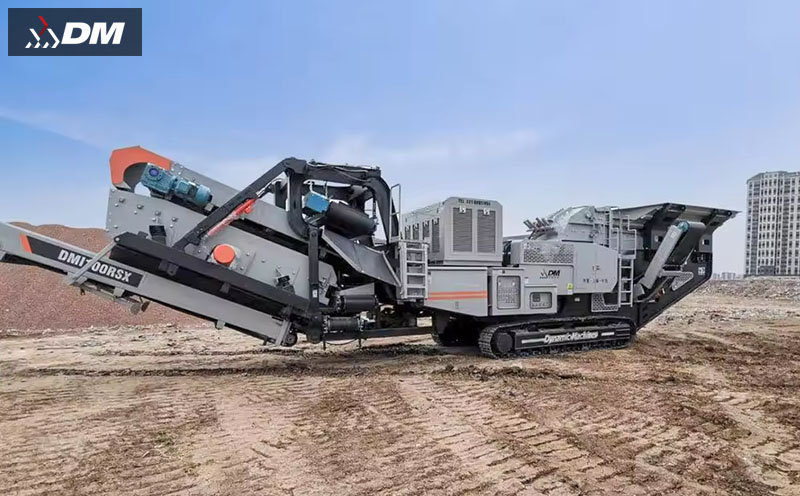
Egypt is experiencing an infrastructure boom — skyscrapers are rising in the New Administrative Capital, the transportation network of the Suez Canal Economic Zone is continuously expanding, and livable facilities in New Alamein City are accelerating. Most of these projects are located in desert or semi-desert areas (accounting for the vast majority of Egypt's land area). The challenges of extreme high temperatures, strong sandstorms, water shortages in desert working conditions, coupled with scattered projects (mostly remote highways, desert mining areas, new city supporting projects), tight construction periods (short-term projects account for more than half), and a shortage of professional operators, have exposed the drawbacks of traditional fixed crushing equipment such as "long infrastructure cycles, difficult transfer, and poor desert adaptability." There is an urgent need for a "desert-specific, rapid-response, intelligent and efficient" crushing solution.
With "deep adaptation to desert working conditions + ready-to-operate rapid response + intelligent remote control for low-manpower operation + environmental compliance and low consumption" as the core, the intelligent remote-controlled mobile crushing and screening plant accurately addresses the scenario pain points of Egypt's infrastructure and mineral development. Whether it is aggregate production for desert highways, ore crushing in remote mining areas, or on-site resource recycling in new city construction, it can achieve "commissioning upon arrival, zero-contact operation, strong environmental adaptation, and low-cost operation," becoming a "mobile high-yield tool" for crushing operations under Egypt's desert working conditions.
I. Core Advantage 1: Deep Adaptation to Desert Working Conditions, Stable Operation in Harsh Environments
Targeting the core challenges of "high temperature, strong sand, and rugged terrain" in Egypt's desert areas, the equipment has undergone special structural and material optimization to achieve stable adaptation to all environments:
- High-temperature resistance design: Core components (motor, hydraulic system) are equipped with independent cooling modules and high-temperature protective coatings, which can withstand low temperatures and extreme high temperatures within a wide temperature range to achieve continuous operation. It avoids equipment shutdown caused by high temperatures at noon in the desert, reducing the failure rate under high-temperature conditions by 80%;
- Strong sandstorm protection: The electrical system adopts IP67 dustproof and waterproof sealing design, and the crushing chamber and screening box are equipped with automatic sand cleaning devices, which can resist the invasion of sand and gravel carried by strong desert winds. The equipment's sand dust failure rate is controlled at an extremely low level, eliminating the need for frequent shutdowns for cleaning;
- Terrain adaptation without pressure: The crawler chassis has low ground pressure and a climbing capacity of 38%, which can freely travel on complex terrains such as desert sand dunes, gravel beaches, and mild mud, easily reaching remote infrastructure construction sites and mining areas; the tire-type model is equipped with puncture-resistant off-road tires, with a relatively fast road transfer speed, adapting to the needs of scattered cross-regional projects in Egypt.
II. Core Advantage 2: Ready-to-Operate Without Infrastructure, Rapid Response to Short Construction Periods
The equipment completely breaks away from the "infrastructure dependence" of traditional crushing lines, perfectly adapting to the needs of short-term projects and emergency material supplement in Egypt, realizing a short-time closed loop of "transportation - deployment - commissioning":
- No foundation construction required: Adopts a fully vehicle-mounted integrated design, integrating feeding, crushing, screening, conveying, and dust removal modules into one. Only a short time of site leveling is needed on-site (direct deployment on desert hard surfaces), saving 95% of infrastructure time and shortening the commissioning cycle by 90% compared with traditional fixed lines;
- Rapid assembly and commissioning: After the equipment is transported to the site, oil circuit, circuit connection and parameter debugging can be completed within a few hours, and production can start immediately. It is especially suitable for the "tight construction period and urgent demand" characteristics of Egypt's infrastructure projects, and can quickly supplement the aggregate supply gap;
- Independent power supply without dependence: Equipped with a Euro V emission standard diesel generator as standard, with an output power covering the medium-high range, it can operate stably without connecting to the power grid, solving the problem of power shortage in remote desert areas and realizing "1,000-ton-class daily output even without electricity;"
- Water-saving design: Adopts dry crushing process, combined with high-efficiency pulse dust removal system, which does not require a large amount of water resources for cooling and dust suppression. Only a small amount of circulating water is needed for equipment lubrication. Water consumption is reduced by 95% compared with traditional wet crushing, perfectly adapting to the water shortage situation in Egypt's desert areas.
III. Core Advantage 3: Intelligent Remote Control for Low-Manpower Operation, Cost Reduction and Efficiency Improvement to Address Shortages
Targeting the shortage of professional operators and rising labor costs in Egypt, the equipment is equipped with an intelligent remote control system, realizing an efficient operation mode of "one person controlling the whole process":
- Remote safe control: Equipped with an industrial-grade wireless remote control terminal with a relatively long remote control distance. Operators can complete full-process operations such as equipment start-stop, adjustment of crushing parameters (discharge particle size, frequency), switching of screening specifications, and walking/steering in a cool area or safe tent in the desert, avoiding high-temperature exposure and dust contact;
- Intelligent monitoring and early warning: Integrates high-definition cameras and multi-dimensional sensors to real-time transmit equipment load, oil temperature, fuel consumption, and output data, and synchronously trigger fault warnings such as belt deviation and insufficient lubricating oil. The remote diagnosis accuracy rate reaches 95%, reducing on-site inspection time;
- Extreme manpower reduction and efficiency improvement: Only 1 person is required to complete the full-process operation of a single unit, saving 75% of labor costs compared with traditional manual models; the Overall Equipment Efficiency (OEE) is stably maintained above 90%, with an hourly capacity covering the low-to-medium to medium-high range, which can meet the daily aggregate demand of desert highways and new city construction, and per capita production efficiency is increased by 350%.
IV. Core Advantage 4: Environmental Compliance and Low Emissions, Aligning with Egypt's Policy Requirements
As Egypt's Environmental Protection Law imposes increasingly strict controls on dust and noise emissions, the equipment achieves compliant operation through full-process environmental protection design, balancing desert ecological protection and policy requirements:
- Precise dust control: Adopts a fully enclosed crushing hood + fully enclosed conveying corridor + high-efficiency pulse bag filter system, with dust emission concentration far below Egypt's environmental limits. There is no visible dust in the open desert environment, avoiding pollution to surrounding oases and residential areas;
- Low-noise design: Core equipment is equipped with sound insulation covers and shock absorption pads, with operating noise controlled at a relatively low level, meeting the standards for operations around Egypt's desert protected areas and residential areas, reducing impacts on the ecological environment and personnel;
- Solid waste resource recycling: For construction waste generated in Egypt's new city construction, the equipment can realize on-site integrated processing of "crushing - screening - recycling," with a recycled aggregate qualification rate of 98%, meeting Egypt's local standards for concrete aggregates. It not only reduces waste transportation costs but also alleviates the pressure of natural aggregate shortage, aligning with the circular economy policy.
V. Core Advantage 5: Strong Localized Adaptation and Support, Worry-Free Long-Term Operation
Combined with the characteristics of the Egyptian market, the equipment has been specially optimized in terms of spare parts supply, training services, and process adaptation to relieve worries about long-term operation:
- Localized spare parts supply: Establishes strategic cooperation with local maintenance enterprises in Cairo and Alexandria, reserves core vulnerable parts (crushing jaws, screens, dust filter elements), shortens the spare parts supply cycle to within 72 hours, and enables rapid replenishment for remote desert projects;
- Bilingual training and services: Provides Arabic + English operation manuals, video tutorials, and on-site training to ensure local employees can work independently in a short time; supports 24/7 remote technical support, with a relatively short fault response time in desert areas, reducing shutdown losses;
- Raw material process adaptation: Can flexibly match jaw crusher (primary crushing), cone crusher (secondary crushing), and impact crusher (tertiary crushing/shaping) modules, accurately adapting to local raw materials in Egypt (limestone, phosphate ore, construction waste). The finished product particle size can be precisely adjusted within a wide range, meeting the needs of various scenarios such as highway subgrade, concrete pouring, and building materials production.
VI. Practical Scenarios in Egypt: Efficient Application in Desert Highways and Mining Areas
An Egyptian engineering company undertook a medium-term desert highway upgrading project in the Sinai Peninsula and a phosphate ore crushing project in the Western Desert. It introduced 3 intelligent remote-controlled mobile crushing and screening plants, realizing efficient operation of "one equipment for multiple scenarios":
- Desert highway scenario: The tire-type model (equipped with jaw + impact crushing modules) was used to process desert gravel and construction waste on-site, with an hourly capacity in the medium-high range and a daily output of 1,000-ton-class highway base aggregates. The finished product quality meets Egypt's highway construction standards, reducing raw material transportation costs by 60% compared with traditional equipment;
- Phosphate mine scenario: The crawler-type model (equipped with jaw + cone crushing modules) was used to process medium-high hardness phosphate ore, with an hourly capacity in the medium-high range. The crushed ore is directly supplied to the concentrator, avoiding long-distance transportation losses and reducing mining area operation costs by 45%;
- Comprehensive benefits: The equipment operated continuously without failure in extreme high temperature and strong sandstorm environments, with only 1 operator per unit, saving 70% of labor costs; the transfer time was relatively short (including transportation), and the transfer cost was 20% of that of traditional equipment; the project was completed ahead of schedule, all environmental testing items met standards, and it was recognized as a "Desert Green Operation Demonstration Equipment" by Egypt's Ministry of Environment.
Conclusion
Against the backdrop of accelerating infrastructure development and normalized operations under desert working conditions in Egypt, the intelligent remote-controlled mobile crushing and screening plant has completely broken the scenario limitations of traditional crushing equipment with its core advantages of "strong desert adaptation, ready-to-operate and high-yield, intelligent low-manpower, and high environmental compliance."
It can not only resist the harsh environment of high temperature and strong sand in the desert but also adapt to the needs of short-term projects with the characteristics of "zero infrastructure and rapid response," and reduce labor and resource costs with the advantages of "intelligent remote control and low-consumption operation." From desert highways to new city construction, from mineral development to solid waste resource recycling, this equipment is becoming a key tool for Egypt to solve the problems of "harsh working conditions, scattered projects, and tight construction periods," injecting flexible, stable, and sustainable green power into Egypt's infrastructure upgrading and efficient development of mineral resources.
If you would like to get help immediately, you can also fill your requirements on the following form, we will contact you on the right time.


Get In Touch